
Gir Cow vs HF Cow: Milk, Breed and Farming Differences

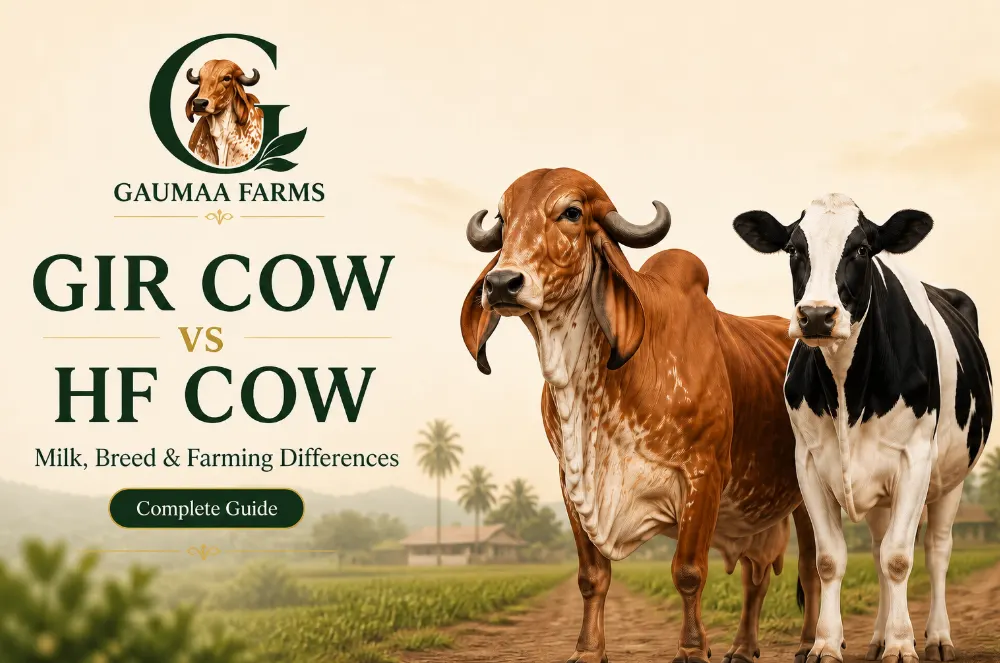
When families compare Gir cow milk with HF cow milk, they are usually asking a bigger question: how do an indigenous Indian cattle breed and a globally popular high-yield dairy breed differ? The answer involves genetics, climate adaptation, milk production, farm management and the specific animal—not one simplistic claim about which cow is universally “best”.
Gir cow and HF cow at a glance
Gir is an indigenous Indian cattle breed associated with Gujarat’s Gir region. Holstein Friesian, commonly called HF in India, is an international dairy breed developed from cattle of the Netherlands and northern Germany. As a result, dairy farmers worldwide recognise HF cattle for their black-and-white markings and high milk-production potential under suitable management.
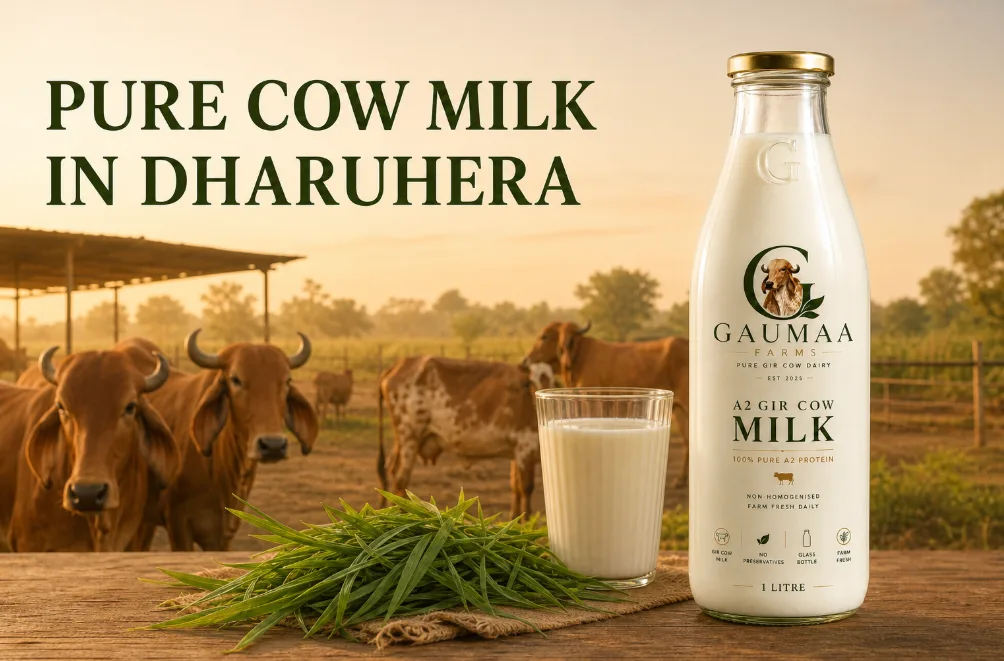
Gaumaa Farms raises indigenous Gir and Sahiwal cows in Nikhri, Dharuhera. Therefore, this comparison explains why the farm values indigenous breeds while avoiding exaggerated or unfair claims about HF cattle.
Gir cow: origin and identifying features
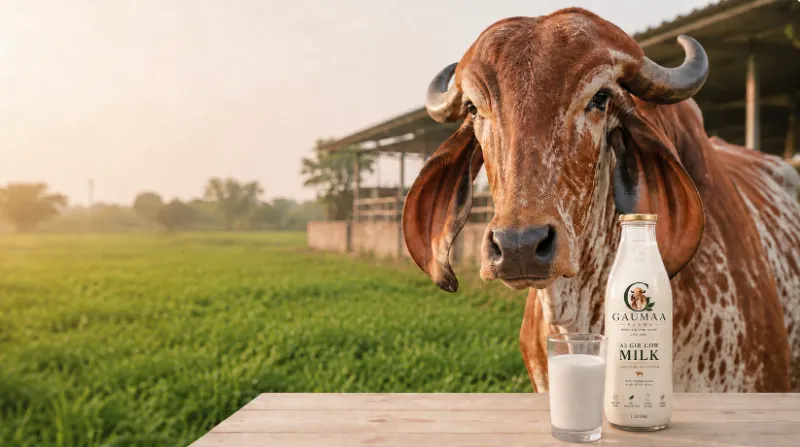
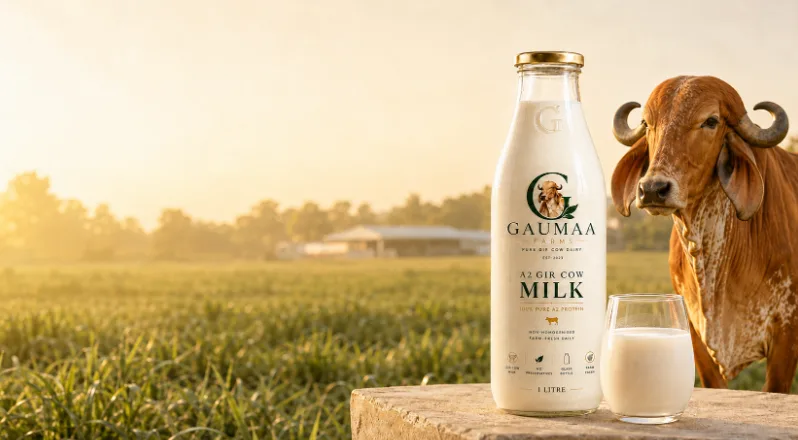
The breed takes its name from the Gir region of Gujarat. Typical features include a broad, prominent and convex forehead; long pendulous ears; horns that curve backwards and upwards; a developed hump; loose skin; and red, reddish-brown or red-and-white-spotted colouring. However, individual animals naturally vary.
Moreover, Gir cattle developed under Indian conditions, and farmers value them as an indigenous milch breed. Even so, their suitability still depends on good nutrition, clean water, shade, housing, veterinary attention and gentle handling.
HF cow: origin and identifying features
In contrast, Holstein Friesian cattle have European origins, and dairy farms now use them across the world. Their familiar appearance includes a large frame and sharply defined black-and-white patches, although red-and-white Holsteins also exist. Above all, farmers know them for strong milk-volume potential.
In India, the term “HF cow” may refer to a purebred animal or an HF crossbred animal. Therefore, this distinction matters because a crossbred cow’s traits can differ according to the other breed involved and the proportion of inheritance.
Gir cow vs HF cow: quick comparison
| Characteristic | Gir cow | HF cow |
|---|---|---|
| Breed background | Indigenous Indian breed | European dairy breed |
| Typical appearance | Red or spotted coat, convex forehead, long ears and hump | Large frame with black-and-white or red-and-white markings |
| Primary dairy reputation | Adaptation and indigenous dairy value | High milk-volume potential |
| Hot-climate management | Developed under Indian conditions | Usually requires particularly careful heat-stress management |
| A2 status | Commonly associated with A2, but individual testing is stronger evidence | Cannot be assumed from appearance; individual genetic testing is required |
| Best choice | Depends on the farm’s climate, resources, welfare standards and production goals | |
Which cow produces more milk?
For instance, breeders around the world select HF cattle for milk volume. With suitable feeding, cooling, housing and health care, these cows can produce large volumes. However, that does not mean every HF cow produces more than every Gir cow. In addition, milk yield varies greatly between individual animals and across lactation.
By comparison, Gir farms may prioritise indigenous genetics, adaptability, long-term herd management, milk characteristics and local conditions rather than maximum litres alone. Therefore, a responsible comparison should never use invented yield figures or treat production volume as the only measure of dairy quality.
Does Gir always produce A2 milk?
People commonly associate Gir cattle with the A2 form of beta-casein. Even so, breed identity is not the same as a laboratory result for every animal. For this reason, individual genetic testing provides stronger support for an A2 claim than coat colour, physical appearance or breed name alone.
In simple terms, A2 describes a variant of beta-casein, one of the proteins in cow’s milk. It does not mean the milk is lactose-free, pasteurised, free from microorganisms or suitable for someone with cow-milk protein allergy. A2 milk should not be presented as a cure or treatment for disease.
Does an HF cow produce only A1 milk?
No responsible farm should make that blanket claim. In fact, Holstein populations can carry different beta-casein genotypes, including A1 and A2 variants. Therefore, the reliable way to know an individual animal’s status is appropriate genetic testing. Therefore, “HF equals A1” and “every indigenous cow equals A2” are both oversimplifications.
Consequently, this is an important distinction for consumers: breed can guide questions, but testing and traceability provide better evidence.
Milk quality is more than A1 or A2
Moreover, milk quality also depends on animal health, udder hygiene, clean milking, water quality, feed, storage temperature, handling and the time between milking and delivery. Fat, protein and other milk solids can change with breed, genetics, season, diet and lactation stage.
Therefore, one label cannot replace a complete farm-quality system. For example, customers should ask who produced the milk, how the animals are managed, whether the milk is raw or pasteurised, how it is tested and how it should be stored at home.
Climate adaptation and heat management
Gir cattle developed in Indian conditions. As a result, farmers generally value their warm-climate adaptability. In contrast, HF cattle originated in a cooler climate and can require stronger heat-management systems in hot weather. For example, farmers can provide effective shade, ventilation, cooling, abundant clean water and carefully designed feeding schedules.
However, farmers can manage HF cattle in India. Still, their welfare and performance depend heavily on the farm’s ability to control heat stress and meet their nutritional and health requirements. Every breed deserves suitable care.
Feeding and daily husbandry at Gaumaa Farms
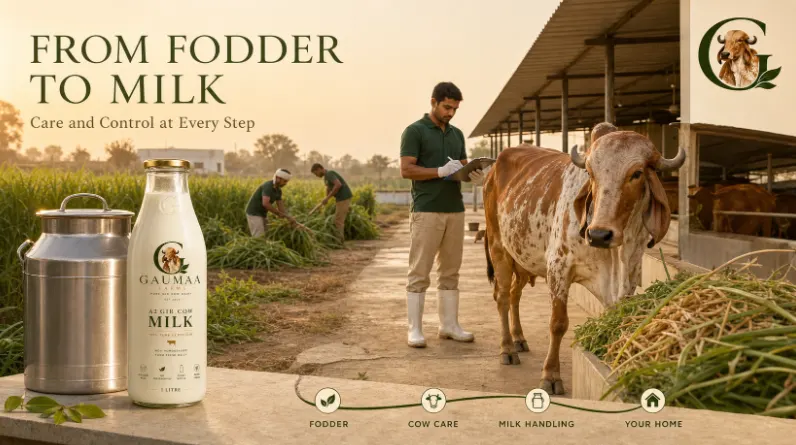
Gaumaa Farms’ Gir and Sahiwal cows receive naturally grown seasonal fodder. Depending on availability, their diet may include neem leaves, ashwagandha, jivanti, giloy, beetroot, moringa, turmeric root, sugarcane, turnip, lemongrass, radish and other seasonal or forest vegetation. The cows may also graze along the Sahibi River bank.
Importantly, these details describe husbandry, diet diversity, grazing and traceability. However, they do not prove that an herb’s medicinal effects transfer into milk. Product-specific laboratory evidence would be required before making such a claim.
Why Gaumaa Farms chooses indigenous cows
For Gaumaa Farms, therefore, choosing Gir and Sahiwal cows forms part of a broader farming philosophy. The focus is on indigenous animals, locally suitable husbandry, varied fodder, supervised care, clean handling and a traceable connection between the farm and local families.
At the same time, this does not require anyone to describe HF cows as “bad”. Instead, a fairer message is that different breeds suit different dairy systems. Gaumaa Farms has chosen a system centred on indigenous cows and A2 milk rather than a model focused mainly on maximum production volume.
Questions to ask before buying A2 milk
- Which cattle breeds does the farm keep?
- How does it support or verify the A2 claim?
- Is the milk raw or pasteurised?
- What do the cows eat?
- How are heat, housing and animal welfare managed?
- What hygiene and batch-quality checks are used?
- How quickly is the milk chilled or delivered?
- What boiling and refrigeration guidance is provided?
Frequently asked questions
Is Gir milk always A2?
Gir cattle are commonly associated with A2 beta-casein, but individual genetic testing is stronger confirmation than breed identity alone.
Is all HF milk A1?
No. HF animals can carry different beta-casein variants. Individual testing is needed.
Which cow gives more milk, Gir or HF?
HF cattle generally have strong milk-volume potential, but actual output depends on the animal, lactation, nutrition, climate and management.
Is A2 milk lactose-free?
No. A2 refers to beta-casein, not lactose.
Where can I order Gaumaa Farms A2 milk?
Contact Gaumaa Farms about current delivery availability in Dharuhera, Bhiwadi and Rewari.
Conclusion
Gir and HF cows represent different dairy-breeding histories and farming priorities. HF cattle offer strong milk-volume potential. Meanwhile, farmers value Gir as an indigenous Indian breed that suits regional conditions. Therefore, neither appearance nor breed name alone proves an individual animal’s A2 status.
In conclusion, Gaumaa Farms chooses Gir and Sahiwal cows as part of its indigenous, traceable farm system. Learn about our farm, explore fresh A2 cow milk or contact Gaumaa Farms for current local availability.
Sources for breed information: ICAR–National Bureau of Animal Genetic Resources and FAO dairy cattle information.