

Curd vs Yogurt: Differences, Cultures, Nutrition and Uses

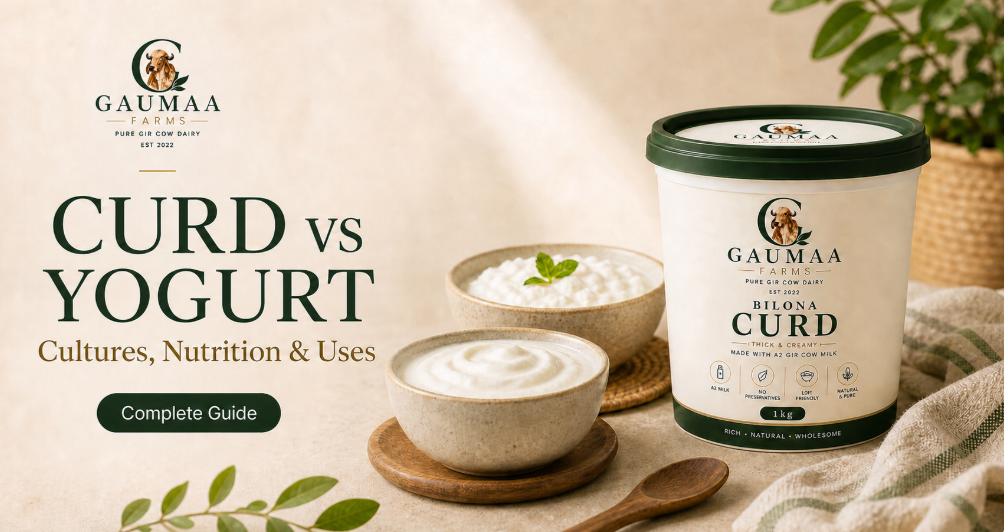
Curd and yogurt both begin with milk, but their cultures, preparation, flavour and labelling can differ.
What is curd?
Curd or dahi is fermented milk commonly made by adding a little existing curd culture to warm milk. Lactic-acid bacteria ferment part of the lactose, increasing acidity and setting the milk into its familiar semi-solid form. Results vary with the milk, starter, temperature, season and fermentation time.
What is yogurt?
Yogurt is also fermented milk, but FSSAI associates it with defined cultures: Streptococcus thermophilus and Lactobacillus delbrueckii subsp. bulgaricus. Dahi may use a broader range of lactic-acid bacteria. Commercial yogurt therefore tends to offer more consistent flavour and texture.
Curd vs yogurt
| Feature | Curd | Yogurt |
|---|---|---|
| Culture | Broader lactic-acid cultures | Defined yogurt cultures |
| Home preparation | Very common | Less culture-controlled |
| Texture | Can vary | Usually standardised |
| Uses | Raita, kadhi, lassi | Bowls, dips and breakfast |
Is every curd probiotic?
No. Fermented and probiotic are not identical claims. A probiotic claim should identify suitable live microorganisms in an adequate amount and be supported for the claimed benefit. Unless those conditions are met, fermented milk is the more accurate description.
What is A2 curd?
A2 curd is made from milk containing A2 beta-casein. Fermentation does not make it lactose-free, suitable for cow-milk protein allergy, automatically probiotic or a treatment for digestive conditions.
How Gaumaa Farms prepares curd
Gaumaa Farms makes curd from A2 milk produced by Gir and Sahiwal cows. Milk is heated, cooled to a suitable temperature, inoculated with starter, allowed to set and then refrigerated. Clean handling and temperature control matter at every stage.
Why the milk source matters
Depending on the season, the cows’ fodder may include moringa, beetroot, turmeric root, sugarcane, turnip, lemongrass, radish, neem leaves and other vegetation. They may graze near the Sahibi River bank. These details explain husbandry and traceability, not medicinal properties transferred into curd.
Plain curd vs flavoured yogurt
Read the complete ingredient list. Flavoured products may contain sugar, fruit preparation, flavours, stabilisers or milk solids. Plain curd is not automatically low-fat, and sweetened yogurt is not automatically unsuitable; composition and serving size matter.
Uses of fresh curd
- Raita with cucumber and cumin
- Kadhi with besan and spices
- Marinades for paneer and vegetables
- Lassi and chhaach
- Parathas and simple home meals
Storage
Keep curd covered and refrigerated. Use a clean, dry spoon and never return served curd to the main container. A little surface whey may be normal, but discard curd showing mould, abnormal colour, unpleasant odour or slime.
Frequently asked questions
Q: Is curd the same as yogurt?
A: Both are fermented milk, but the defined cultures may differ.
Q: Is curd lactose-free?
A: No, although fermentation may reduce some lactose.
Q: Is all curd probiotic?
A: No.
Q: Can someone with a milk allergy eat A2 curd?
A: No. It contains cow’s milk proteins.
Q: Where is Gaumaa curd available?
A: Dharuhera, Bhiwadi and Rewari, subject to availability.
Conclusion
Choose according to ingredients, culture, freshness, storage and intended use. Explore fresh A2 curd or contact Gaumaa Farms.
Source: FSSAI fermented-milk standard.