How Gaumaa Farms Controls the Journey from Fodder to Milk

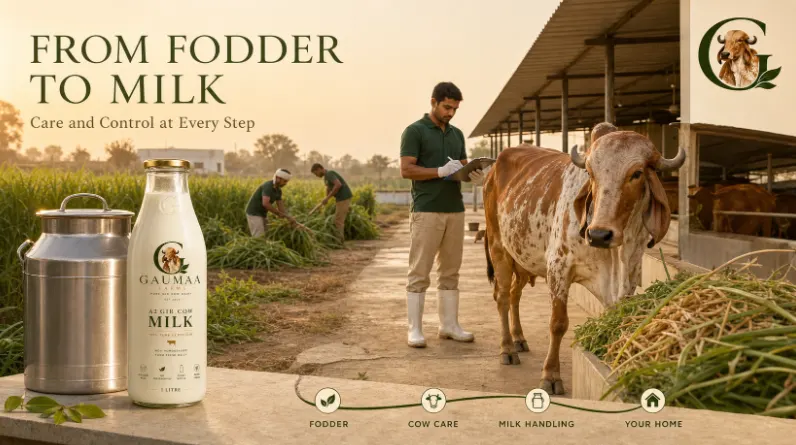
Gaumaa Farms controls the journey from fodder to milk by managing its own cows, supervising fodder cultivation, observing animal health, maintaining defined milking routines and connecting customers directly with the farm. This does not make milk a medicine or remove the need for food-safety precautions. It gives customers something more practical: a dairy system whose important stages can be identified, questioned and improved.
Most milk marketing begins at the bottle. Words such as “pure,” “natural,” “premium” and “farm fresh” appear prominently, while the cow, soil, fodder, veterinary records and milking environment remain invisible.
Gaumaa Farms takes a different approach. The family promise is simple: we want to offer customers only food that we would confidently serve in our own home. That promise must be supported by real practices rather than emotional language alone. Therefore, this article follows the complete journey—from soil and fodder to cow care, milking, checking, raw-milk handling and local delivery.
Why milk quality begins before milking
A dairy cannot create responsible milk production at the final packaging stage if earlier controls are unknown. Milk production begins with animal genetics, nutrition, water, housing, movement, health observation and veterinary decisions. It continues through udder preparation, clean equipment, milk collection, storage and transport.
The FAO Guide to Good Dairy Farming Practice treats animal health, milking hygiene, nutrition, welfare, environment and socioeconomic management as connected parts of good farming. It also recommends traceability for feed brought onto a farm.
This is the central idea behind Gaumaa’s “fodder-to-milk” approach: customers should be able to understand more than the product name.
Step 1: A known farm in Nikhri, Dharuhera
Gaumaa Farms is located in Nikhri, Dharuhera, in Haryana’s Rewari district. A physical farm location matters because it connects the brand with a place, a team and an environment that customers can ask about.
A known location is not proof that every practice is perfect. However, it makes responsibility less anonymous. Customers can enquire about the herd, feeding, product availability and a scheduled farm visit.
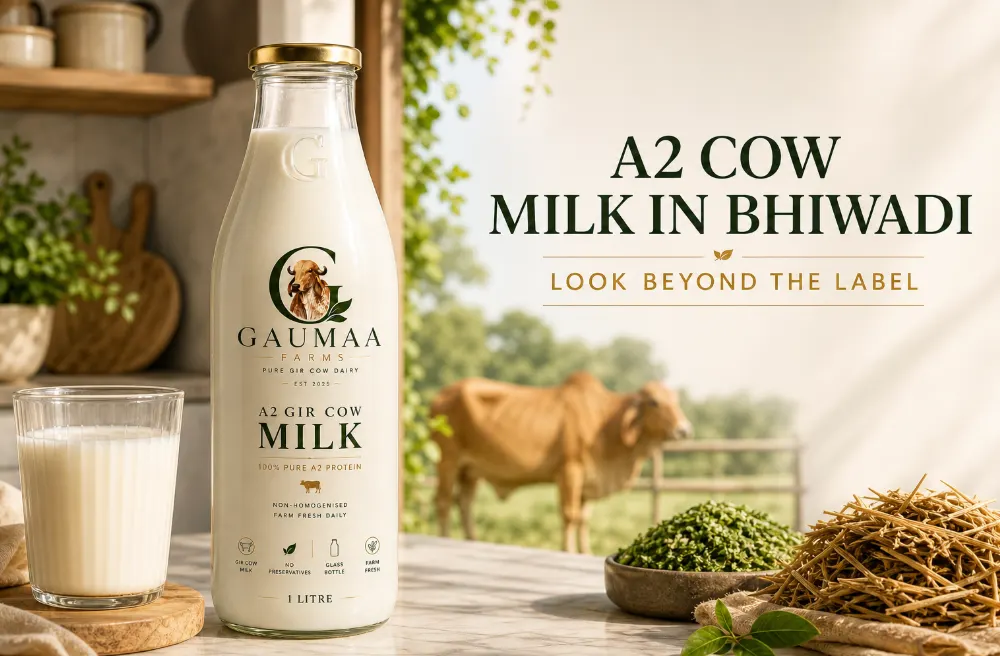
Gaumaa supplies raw A2 cow milk, paneer, traditional Bilona curd, lassi, makhan and Bilona ghee. Milk, curd and lassi delivery covers selected routes in Dharuhera, Bhiwadi and Rewari, subject to availability. Ghee may be available for customers in a wider area, including Gurgaon and Delhi, but availability must be confirmed directly.
Step 2: Indigenous Gir and Sahiwal cows
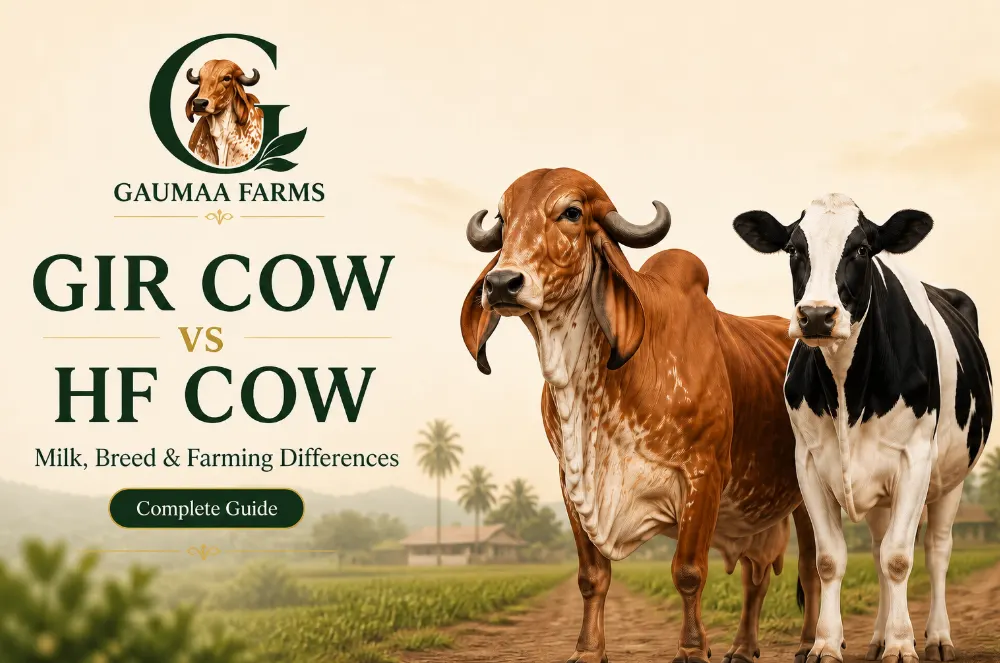
Gaumaa raises Gir and Sahiwal cows. Both are indigenous Indian cattle breeds commonly associated with the A2 beta-casein variant. Nevertheless, responsible communication requires an important qualification: breed is an indicator, while individual genetic testing provides stronger evidence of a cow’s beta-casein genotype.
A2 status comes primarily from genetics. It does not come from feeding a cow herbs, allowing her to graze or using traditional preparation methods. Likewise, A2 does not mean lactose-free, allergy-safe, pathogen-free or medically therapeutic.
The cow breed matters to Gaumaa, but the farm does not want breed to become the entire story. A Gir or Sahiwal cow still requires appropriate nutrition, clean water, shelter, movement, observation and responsible veterinary care.
Step 3: Freedom of movement and a familiar environment
Gaumaa cows are not routinely kept tied with ropes throughout the day. They can move within the farm, use organised feeding areas, drink water and rest within familiar spaces. The farm layout prioritises airflow, accessible water and cleaner routines.
Animal welfare is complex and cannot be reduced to one photograph of a cow standing outdoors. Space must still be managed, floors maintained, weather considered, water kept accessible and animals observed. Freedom of movement is one visible part of a larger husbandry system.
Gaumaa also values mother–calf contact, gentle handling and continued responsibility for young, mature and ageing animals. These are farm-practice commitments. We will not convert them into unsupported claims that “happy cows cure disease” or that a particular emotion can be measured in the final milk without evidence.
Step 4: Fodder grown under farm supervision
A major Gaumaa difference is oversight of fodder cultivation. The farm grows fodder on its own farmland and uses natural fertiliser made from cow dung. Gaumaa states that it does not apply synthetic chemical fertilisers, pesticides or artificial growth enhancers to those fodder crops.
This statement must not be inflated into an organic certification unless a valid certification supports it. The direct benefit is traceability. The farm can explain how the fodder was cultivated instead of relying entirely on unknown external feed sources.
The cow-dung cycle also connects different parts of the farm:
- The cows produce dung as part of daily farm life.
- The farm prepares natural fertiliser from that material.
- The fertiliser supports soil used for fodder crops.
- The harvested fodder returns to the cow-feeding system.
This is not a claim that manure alone supplies every agronomic need or eliminates all environmental risk. It describes how Gaumaa closes part of the farm cycle and retains more oversight over its fodder.
Step 5: Green fodder, dry fodder and seasonal variety
A cow’s diet should not be described as one magical ingredient. Animals require a balanced feeding programme that considers age, body condition, health, lactation stage and available forage.
Gaumaa cows receive green fodder, suitable dry fodder or roughage and additional nutrition according to farm requirements. Seasonal availability means the exact combination can change.
Depending on the season and grazing environment, cows may eat or encounter neem leaves, moringa, beetroot, turmeric root, sugarcane, turnip, lemongrass, radish, ashwagandha, jivanti, giloy and other local or forest plants. Some cows also graze in areas associated with the Sahibi River bank, where grasses and seasonal vegetation vary naturally.
Gaumaa shares this list to describe husbandry and dietary variety. It does not claim that neem, giloy, ashwagandha or another plant transfers a medicinal dose into milk. Proving such a claim would require product-specific laboratory analysis and appropriate clinical evidence.
Step 6: Clean water and organised feeding
Feed stories often receive attention because they make attractive photographs. Water receives less attention, although dairy animals need dependable access to clean water. Gaumaa’s farm environment includes accessible water and organised feeding areas designed to make daily routines easier to observe and maintain.
Organised feeding also helps the team notice changes. A cow that suddenly eats less, moves differently or separates herself from the routine may need closer attention. Observation does not replace veterinary diagnosis; it helps the farm notice when professional assessment may be necessary.
Step 7: Individual observation and responsible treatment
Cows can become ill even on a well-managed farm. Refusing necessary medicine would not be responsible animal care. The relevant food-safety question is whether treated animals are identified and whether their milk remains outside the food supply for the required withdrawal period.
Withdrawal time is the interval after a medicine is administered during which milk must not be sold for human consumption, according to the medicine’s instructions and veterinary guidance. The period differs between medicines and treatment conditions.
The FAO Code of Hygienic Practice for Milk and Milk Products states that milk from animals treated with veterinary drugs capable of transferring to milk should be appropriately discarded until the specified withdrawal period has been completed.
At Gaumaa Farms, milk from a cow under an applicable withdrawal restriction must remain outside customer milk and outside paneer, curd, lassi, makhan and ghee production. Its handling or disposal should follow veterinary direction. It should not automatically be described as calf feed.
Step 8: Milking hygiene and milk separation
Responsible milk handling requires more than a healthy cow. Udders, hands, vessels, contact surfaces and storage containers can all influence contamination risk. Defined routines help reduce uncertainty and make mistakes easier to identify.
Gaumaa’s farm-controlled model keeps animal observation and milk handling within one connected operation. The key promise is accountability, not an impossible claim of zero microorganisms.
If milk appears abnormal or comes from an animal that should not contribute to the customer supply, it must be kept separate. Once unsuitable milk enters a combined vessel, it can affect the larger batch and becomes harder to trace.
Step 9: Daily milk-batch checks
Gaumaa states that each milk batch is checked using an Ultrasonic Milk Analyzer. Such equipment can support routine checks of selected compositional parameters. However, an ultrasonic analyser cannot be honestly presented as one machine that proves everything.
Depending on the model and calibration, it may provide measurements related to composition. It does not automatically replace microbiological analysis, antibiotic-residue testing or laboratory methods for every possible adulterant.
Therefore, Gaumaa should describe the analyser as one part of daily checking within a wider system of cow care, milk separation, hygiene and customer handling guidance.
Step 10: Raw milk with a clear boiling instruction
Gaumaa supplies raw, unpasteurised A2 milk. Raw milk can contain harmful microorganisms even when the farm follows good hygiene. Gaumaa therefore instructs customers to boil the milk before consumption and refrigerate it promptly.
The word “fresh” should never be used to imply that raw milk needs no heat treatment. Public-health guidance is especially important for children, pregnant women, older adults and people with weakened immunity.
Read the detailed comparison of raw milk vs pasteurised milk and the existing guide on boiling and storing fresh A2 milk.
Step 11: Local farm-to-home accountability
A local supply chain does not automatically guarantee safety or purity. Its practical advantage is that customers can know who is responsible and ask specific questions.
Gaumaa’s milk, curd and lassi routes cover Dharuhera, Bhiwadi and Rewari, subject to availability. Customers should confirm service for their address. The farm does not need to promise delivery everywhere to demonstrate value. It needs to give accurate answers where it operates.
What “fodder to milk” does not prove
Transparent marketing must include limitations. Gaumaa’s farm practices do not, by themselves, prove that:
- The milk prevents or treats disease.
- Herbs create medicinal milk.
- A2 milk is lactose-free.
- A2 milk is suitable for cow-milk protein allergy.
- Raw milk is safe to drink without boiling.
- One analyser verifies every possible contaminant.
- Every batch has identical taste, fat, colour or malai.
Natural variation can occur with season, feed, lactation stage and other biological factors. Transparency means explaining that variation, not hiding it with an unsupported promise of perfect uniformity.
Questions customers should ask any dairy farm
- Can you identify the farm and herd behind the milk?
- Do you collect milk from outside suppliers?
- What do the cows eat, and how is fodder sourced?
- How are treated cows identified?
- How is withdrawal-period milk kept separate?
- Is the milk raw or pasteurised?
- What does your daily testing actually measure?
- How should customers boil and refrigerate the product?
- Can customers see real farm images or arrange a visit?
- Which claims are supported by certificates or test reports?
Gaumaa should be prepared to answer these questions because customers paying for carefully produced food deserve more than a slogan.
Frequently asked questions
Where is Gaumaa Farms located?
Gaumaa Farms is located in Nikhri, Dharuhera, Rewari district, Haryana.
Which cows does Gaumaa Farms raise?
The farm raises indigenous Gir and Sahiwal cows. These breeds are commonly associated with A2 beta-casein, although genetic verification is stronger evidence than breed alone.
Does Gaumaa use organically certified fodder?
Gaumaa states that it grows fodder under its own supervision using cow-dung-based natural fertiliser and without synthetic chemical fertilisers, pesticides or artificial growth enhancers on those crops. This should not be described as certified organic unless valid certification supports that term.
Do herbs eaten by cows make the milk medicinal?
Gaumaa makes no such claim. Dietary variety is part of husbandry, but medicinal transfer into milk would require product-specific evidence.
Can customers visit the farm?
Customers can contact Gaumaa to enquire about a scheduled farm visit. Visits should be arranged in advance.
The Gaumaa family standard
“We sell our customers only what we would serve our own family” is an emotional promise. Its value depends on the system behind it.
For Gaumaa Farms, that system begins with the land used for fodder. It continues through indigenous cows, movement, feeding, water, daily observation, responsible veterinary treatment, milk separation, checking and clear raw-milk instructions. It ends with direct accountability to families in the local delivery area.
If you want to understand the source behind your milk, explore the Gaumaa farm, view the A2 cow milk product, or contact Gaumaa Farms to check availability in Dharuhera, Bhiwadi or Rewari.
Sources: FAO Guide to Good Dairy Farming Practice; FAO Code of Hygienic Practice for Milk and Milk Products; FAO Milk and Dairy Products in Human Nutrition.