
Pure A2 Milk Supplier in Dharuhera: What Families Should Verify

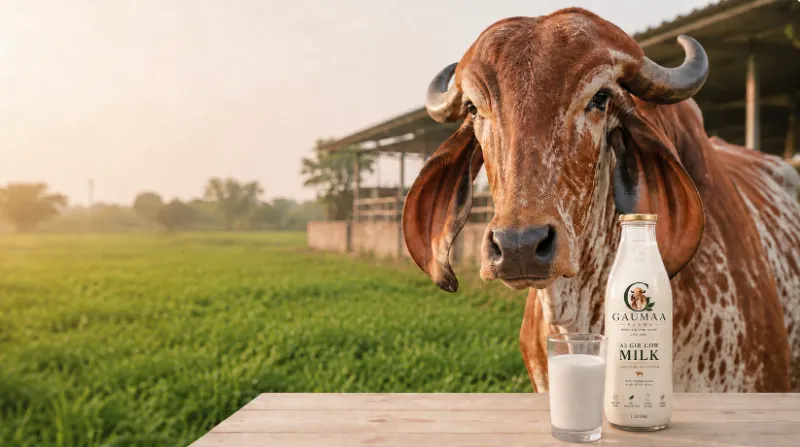
Pure A2 milk supplier in Dharuhera. This local commercial guide helps families compare a real supplier, not just read generic nutrition claims.
Pure A2 milk supplier in Dharuhera: a direct answer
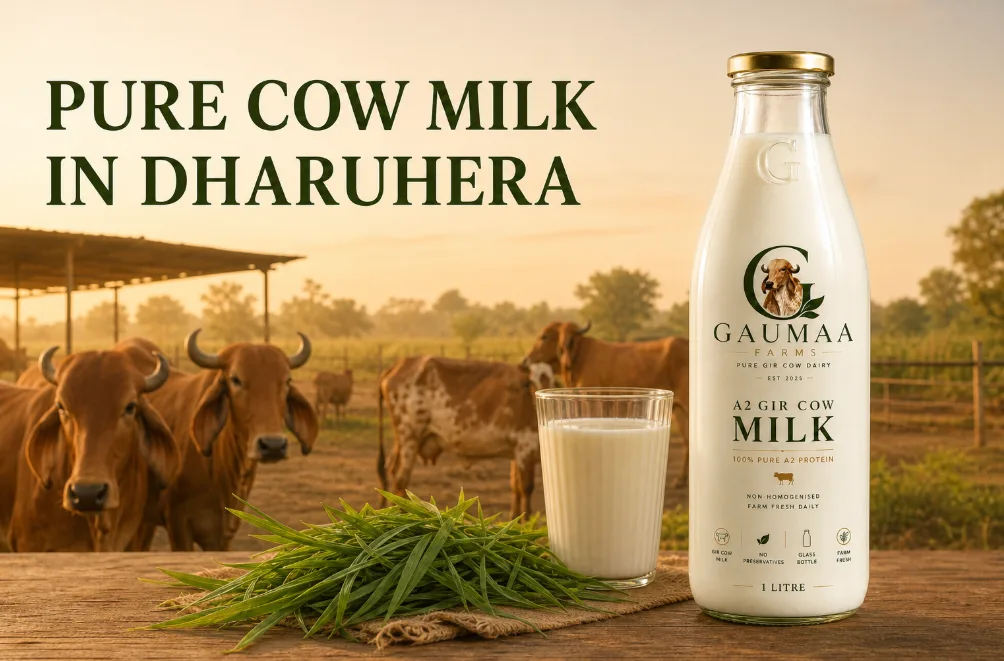
Gaumaa Farms is based in Nikhri, Dharuhera, Rewari, Haryana. We supply raw A2 cow milk from the Gir and Sahiwal cows we manage at our own farm, subject to the current delivery route. For families searching for pure A2 milk in Dharuhera, our difference is not a decorative label. It is the ability to explain the cow, feed, treatment control and milk journey.
Colour, thickness or malai alone cannot define purity. Instead, buyers should verify mixing, source traceability, treatment-period separation, raw-milk disclosure and home-handling guidance. We aim to sell only what we would confidently serve our own family.
What Dharuhera families should verify before subscribing
- A real farm address and identifiable herd
- Gir or Sahiwal cows managed by the supplier
- Balanced green and dry fodder rather than vague herb claims
- Individual observation and medicine-withdrawal separation
- Honest raw-milk boiling and refrigeration guidance
- Current delivery coverage for the customer’s sector or society
- A reachable person who accepts questions and complaints
Why our Nikhri location matters
Local proximity does not prove purity, but it makes accountability practical. Our customers can connect the product to a nearby farm instead of an unknown chain. We manage our cows in one environment, grow fodder with cow-dung fertiliser and allow the animals room to move rather than keeping them continuously tied. Seasonal grazing may expose them to varied plants near the Sahibi River bank; we present that as husbandry, not as proof that medicinal effects enter milk.
Looking for A2 cow milk delivery in Dharuhera? Start by checking the farm, cow breed, milk source, treatment-milk policy, handling instructions and delivery coverage not only the price per litre. Gaumaa Farms supplies raw A2 cow milk from its farm in Nikhri, Dharuhera, to selected routes in Dharuhera, subject to availability. The farm raises indigenous Gir and Sahiwal cows and asks customers to boil the milk before consumption.
At first, a daily milk purchase can look simple. The container arrives, the family boils it, and the milk goes into tea, curd, paneer or breakfast. Yet the quality of that milk depends on a chain of decisions that farmers make before the milk reaches the kitchen: which cows produced it, what they ate, whether an animal was receiving veterinary treatment, how the milk was collected and how clearly the supplier can answer questions.
This Dharuhera buying guide explains what “A2” means, what it does not mean, how to compare milk suppliers and how Gaumaa Farms approaches local farm-to-home supply.
Benefits of choosing Gaumaa A2 milk in Dharuhera
In addition, milk is one of the most useful everyday foods in an Indian home. It contributes high-quality protein for normal growth and muscle maintenance. It also supplies calcium for bones and teeth. Families can drink it, add it to breakfast, set fresh curd, prepare paneer or use it in traditional recipes. Therefore, choosing a dependable source can improve both nutrition and everyday convenience.
Useful nourishment for growing children
Children need enough protein, calcium and overall energy for normal growth and development. Milk can help families provide those nutrients in a familiar form. It does not replace a varied diet, sunlight, physical activity or medical advice. However, it can support a balanced family menu through milk, curd, paneer and lassi.
Protein for adults and older family members
Similarly, adults need protein to maintain body tissues and muscle. Older people also benefit from meeting their protein and calcium needs through foods they enjoy and can include regularly. Milk, curd and soft paneer offer flexible choices for different meals.
Fresh flavour with many household uses
For example, our raw A2 cow milk can become tea, kheer, curd, lassi, paneer, makhan and Bilona ghee. This versatility gives families more value from one traceable ingredient. In addition, the natural flavour and cream make traditional preparations feel connected to the farm rather than to an anonymous supply chain.
The confidence of a nearby, accountable farm
Gaumaa Farms is in Nikhri, Dharuhera, within Rewari district. We raise our own Gir and Sahiwal cows and manage their feed, environment and daily observation. As a result, Dharuhera customers can ask direct questions about the milk they serve at home.
What A2 means in our milk
A2 describes a beta-casein protein variant commonly associated with indigenous breeds such as Gir and Sahiwal. For us, the value goes beyond that label. We combine A2 milk with our farm-controlled herd, freely moving cows, balanced green and dry fodder, individually monitored animals and treatment-period separation.
That complete system gives customers more than a protein description. It gives them a local source, familiar taste and a team that accepts responsibility for the journey from fodder to milk.
Why “A2 cow milk delivery Dharuhera” is a source question
Searching for home delivery is convenient, but the nearest seller is not automatically the most transparent supplier. Milk can be sold through several models:
- A farmer may deliver milk from the farmer’s own animals.
- A milkman may collect milk from several households or farms.
- A dairy may pool milk, process it and distribute it under one brand.
- A farm brand may manage its herd and sell directly to local customers.
Operators can manage each model responsibly or poorly. The amount of verifiable information creates the difference for customers. Once a collector combines milk from unrelated animals and suppliers, tracing a concern back to a particular cow, feed source or treatment record becomes more difficult.
The FAO discussion of milk and dairy products in human nutrition recognises that increasingly complex milk chains can make it harder to trace faults back to an ingredient, farm, animal or feed. Traceability does not guarantee perfection, but it makes responsibility clearer.
Ten questions to ask before choosing milk delivery in Dharuhera
1. Which farm produced today’s milk?
A supplier should identify the source. “Fresh cow milk” is not a complete answer if the customer cannot learn which farm or herd produced it. Ask whether the seller collects and combines milk from outside suppliers before delivery.
Gaumaa Farms operates from Nikhri, Dharuhera, in Rewari district. Customers can connect the milk with a physical farm rather than only a delivery vehicle or label.
2. Which cow breeds contribute to the milk?
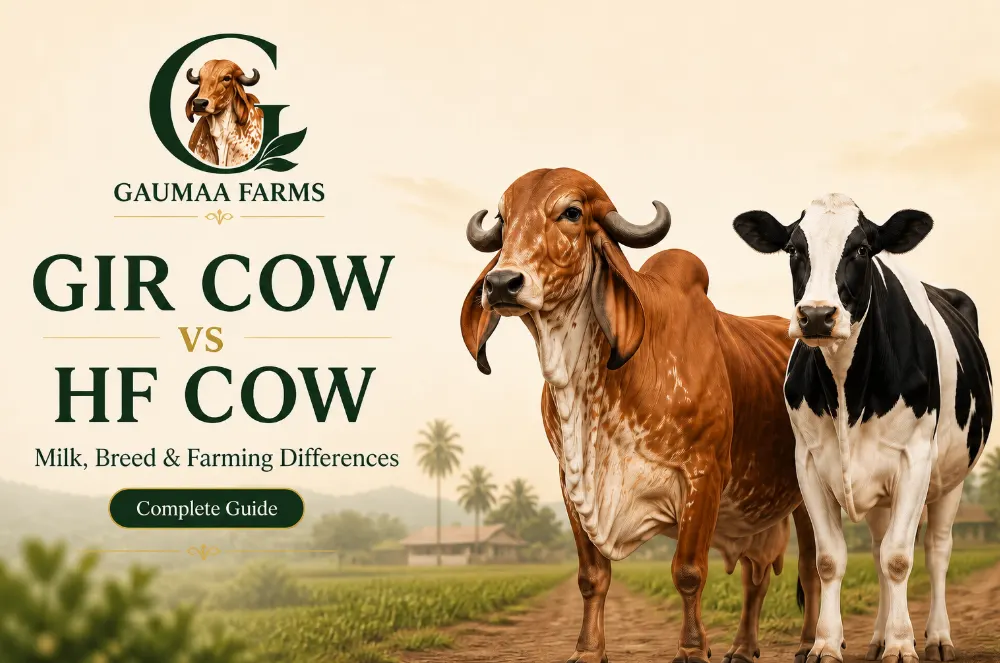
Gaumaa raises indigenous Gir and Sahiwal cows. People commonly associate these breeds with the A2 beta-casein variant, although breed alone is not as conclusive as individual genetic testing. We will not claim that we have genetically verified every animal unless corresponding records support that statement.
3. Is the milk from one managed farm or several unknown sources?
Mixed collection is not proof of adulteration. However, it can create a traceability gap. A known single-farm source gives the producer more direct visibility over feeding, animal observation, treatment and milking routines.
Gaumaa offers a clear advantage: we can account for the cows, fodder and farm practices behind the milk. That visibility helps customers choose with greater confidence.
4. What do the cows eat?
“The cows eat grass” is too vague. Dairy animals need appropriate green fodder, dry roughage, clean water and nutrition suited to age, health and stage of lactation.
Gaumaa manages seasonal fodder and suitable roughage within the farm system. Depending on the season and availability, cows may receive or encounter plants such as neem leaves, moringa, beetroot, turmeric root, sugarcane, turnip, lemongrass, radish, ashwagandha, jivanti, giloy and other local vegetation while grazing.
These details describe feeding and husbandry. They do not prove that the medicinal properties traditionally associated with a plant transfer into milk.
5. How is the fodder grown?
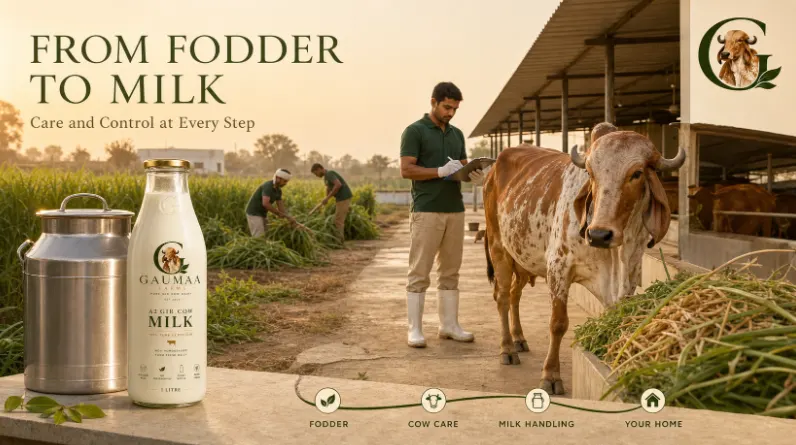
Gaumaa states that fodder is grown on its own farmland under direct supervision. The farm uses natural fertiliser made from cow dung and states that it does not use synthetic chemical fertilisers, pesticides or artificial growth enhancers on those fodder crops.
This is a farm-practice statement, not an organic certification claim. The value comes from direct oversight: we can explain how we cultivate our fodder instead of making assumptions about an unknown source.
6. How are cows monitored?
Daily observation should include appetite, movement, visible condition and changes that may require attention. A known herd also makes it easier to identify a particular cow when something changes.
Gaumaa’s farm layout supports organised feeding, accessible water, airflow and regular observation. Moreover, our cows can move within the farm instead of remaining routinely tied throughout the day.
7. What happens when a cow needs medicine?
Responsible animal care sometimes requires veterinary treatment. The issue is not whether a cow ever receives medicine. The issue is whether the farm records the treatment and excludes her milk for the prescribed withdrawal period.
The withdrawal period is the time required after treatment before milk may re-enter the food supply under the medicine’s instructions and veterinary guidance. During this period, the treated cow’s milk must not enter customer milk or products such as paneer, curd, lassi, makhan and ghee.
FAO dairy-hygiene guidance states that milk from animals treated with veterinary drugs that can transfer to milk farmers should keep it out of the food supply until they complete the specified withdrawal period. Read more in the FAO Code of Hygienic Practice for Milk.
8. Is the milk raw or pasteurised?
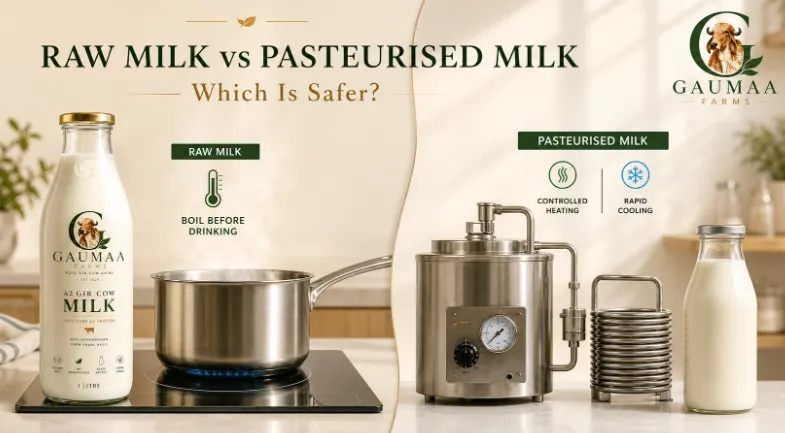
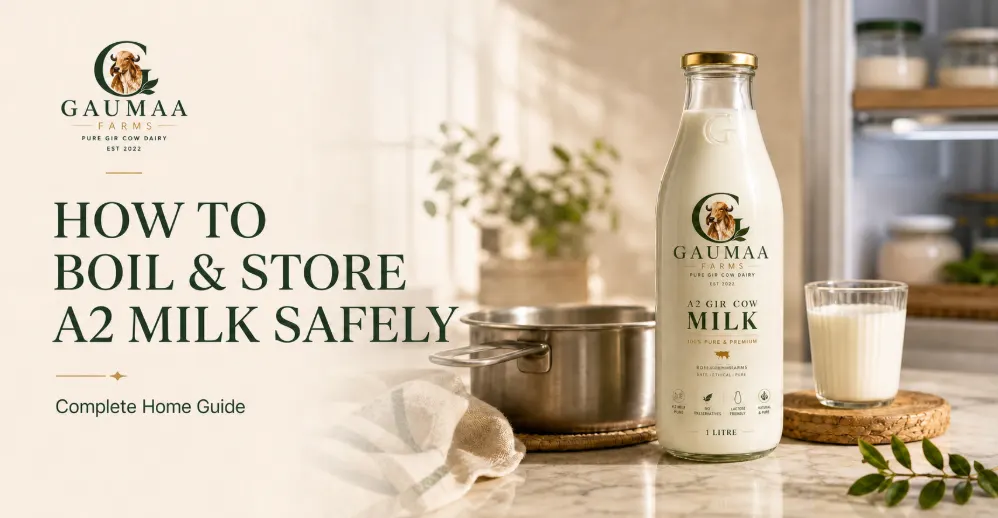
Gaumaa supplies raw, unpasteurised milk. Therefore, we state this fact clearly because raw milk requires careful handling at home. Gaumaa advises customers to boil it before consumption and refrigerate it promptly.
A clean farm can reduce contamination risk but cannot guarantee that untreated raw milk contains no harmful microorganisms. For a detailed explanation, read our guide to raw milk vs pasteurised milk once published.
9. How is the milk checked?
Gaumaa states that our team checks each batch with an Ultrasonic Milk Analyzer. Such an instrument can support routine checks of certain compositional parameters. However, one reading cannot prove that milk is free from every pathogen, veterinary medicine or possible adulterant.
Customers should be cautious when a supplier uses one machine or one photograph to imply that one device answers every possible safety question.
10. Can the supplier confirm delivery for your address?
Gaumaa’s stated milk, curd and lassi service area includes Dharuhera, Bhiwadi and Dharuhera. However, delivery depends on the active route and product availability. Customers should contact the farm with their locality before assuming service.
We will not invent delivery times, free trials, subscription prices or guaranteed availability. A precise answer for a real address is better than a broad promise made only for SEO.
Gaumaa Farms vs an unverified mixed milk supply
| What to check | Unverified mixed supply | Gaumaa Farms approach |
|---|---|---|
| Farm identity | May not be clear to the buyer | Farm in Nikhri, Dharuhera |
| Breed information | May involve unknown animals | Gir and Sahiwal cows |
| Fodder source | May differ among suppliers | Farm-supervised fodder cultivation |
| Animal observation | Procedures may be unavailable | Known herd within one farm system |
| Treatment milk | Separation procedure may be unclear | Must remain outside saleable products during withdrawal |
| Raw-milk disclosure | May not be explained clearly | Sold as raw milk with boiling guidance |
| Accountability | Source may be difficult to trace after pooling | Customers can contact or visit the farm by arrangement |
This table does not allege that every milkman or outside supplier fails these controls. It shows what a customer may be unable to verify when the source is not disclosed.
How to handle Gaumaa raw A2 milk after delivery
- Receive the milk in a clean container.
- Boil it before consumption.
- Use clean utensils and avoid cross-contamination.
- Cool the boiled milk safely without leaving it exposed.
- Refrigerate it promptly in a covered container.
- Keep newer and older batches separate where practical.
- Discard milk showing unusual spoilage signs rather than tasting it.
Raw A2 milk is not lactose-free. It is also unsuitable for anyone with a diagnosed cow-milk protein allergy. Speak with a qualified health professional about individual dietary suitability.
What can Dharuhera families make with A2 cow milk?
Households commonly use fresh cow milk for tea, coffee, breakfast, curd, paneer, kheer and other recipes. The result can vary naturally with fat content, season, lactation stage and handling. More or less malai does not by itself prove purity or adulteration.
Gaumaa also offers paneer, traditional Bilona curd, lassi, makhan and Bilona ghee. Please check current availability and delivery coverage directly. The important connection is the milk source and farm process, not a claim that each product cures or prevents illness.
Milk delivery during Dharuhera’s hot weather
Local delivery does not remove the need for temperature control. Milk is perishable, and Haryana’s warmer months make prompt handling particularly important. Customers should plan for delivery rather than allowing a container to remain outside the home for an extended period.
Before subscribing, ask where the delivery person will place the milk, whether someone will receive it and what the supplier expects the household to do immediately afterward. If delivery occurs before the family wakes, use an agreed clean and shaded receiving arrangement. Do not leave raw milk in direct sunlight, inside a warm vehicle or near a cooking area.
After receiving Gaumaa raw milk, boil it according to the supplied guidance and refrigerate it promptly after safe cooling. If immediate boiling is not possible, place the closed container in the refrigerator without unnecessary delay. Clean the receiving vessel and storage container properly between batches.
This practical routine may seem less exciting than claims about “superfood milk,” but it protects the product that the farm has worked to produce. A good delivery service and a careful household share responsibility for the final condition of milk served to the family.
Frequently asked questions
Does Gaumaa Farms deliver A2 cow milk in Dharuhera?
Gaumaa includes Dharuhera in its stated milk-delivery area. Contact the farm with your exact locality to confirm the active route and current availability.
Is Gaumaa A2 milk pasteurised?
No. Gaumaa describes its milk as raw and unpasteurised. Boil it before drinking and refrigerate it promptly.
Which cows produce Gaumaa milk?
Gaumaa Farms raises indigenous Gir and Sahiwal cows. Breed is relevant to sourcing, although individual genetic testing is stronger evidence of A2 status than breed alone.
Is A2 milk safe for lactose intolerance?
A2 milk contains lactose. Some research has investigated digestive responses to A1- and A2-containing milk, but we should not describe A2 milk as lactose-free.
Can I visit Gaumaa Farms?
The farm invites customers to enquire about a scheduled visit. Contact the team in advance to confirm a suitable time rather than arriving without an appointment.
Choose milk whose source can answer your questions
The best A2 cow milk delivery in Dharuhera is not determined by a label, thick malai or the lowest price. A serious buyer should examine the farm, herd, fodder, treatment policy, raw-milk disclosure and handling guidance.
Gaumaa Farms’ strongest point is accountability across a connected system: a known farm in Nikhri, indigenous cows, farm-supervised fodder, animal observation, treatment-milk exclusion and clear household boiling advice.
If you are looking for A2 cow milk delivery in Dharuhera, contact Gaumaa Farms to confirm service for your locality. You can also explore the farm story and view the Gaumaa A2 cow milk product.
Sources: FAO Guide to Good Dairy Farming Practice; FAO dairy hygiene and veterinary-drug guidance; FAO milk and dairy nutrition report.