
Raw Milk vs Pasteurised Milk: Which Is Safer?

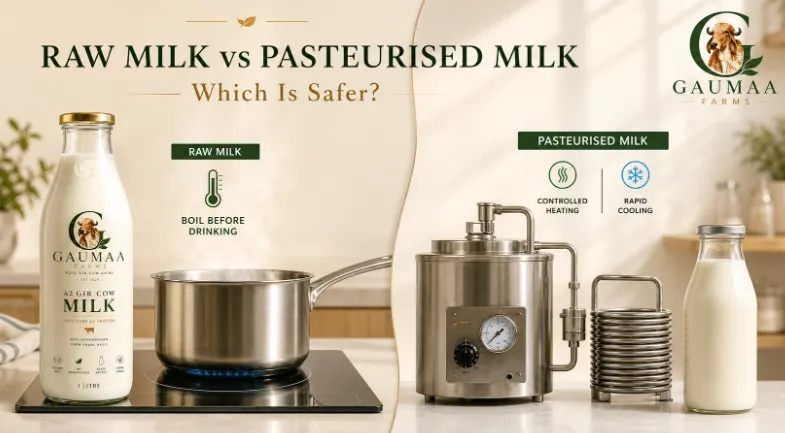
Quick answer: Pasteurised milk is safer to drink without further heat treatment because pasteurisation is designed to destroy disease-causing microorganisms. Raw milk has not received that treatment, so clean farming can reduce contamination risk but cannot remove it completely. Gaumaa Farms supplies raw A2 cow milk and therefore advises customers to boil it before consumption, cool it safely and refrigerate it promptly.
When families search for raw milk vs pasteurised milk, they often encounter two extreme claims. One side presents raw milk as automatically healthier because it is less processed. The other treats every raw-milk supplier as careless. Neither position helps a buyer make a responsible choice.
The useful questions are more practical. What does “raw” actually mean? What does pasteurisation do? Can a clean farm guarantee that raw milk contains no harmful organisms? Does boiling change A2 beta-casein? What should a household do when raw milk arrives at the door? This guide answers those questions and explains how Gaumaa Farms approaches raw A2 milk delivery in Dharuhera, Bhiwadi and Rewari.
What is raw milk?
Raw milk is milk that has not been pasteurised. It comes from the animal and may then be filtered, cooled, packed or transported, but it has not gone through a validated pasteurisation process.
“Raw” describes processing. It does not tell you whether the milk is A1 or A2, whether it came from a Gir cow, whether it is organic, or whether it is free from microorganisms. Likewise, raw milk is not automatically adulterated or automatically pure. Those are separate questions.
At Gaumaa Farms, the term raw milk is used plainly: the milk is supplied unpasteurised. Customers are instructed to boil it before drinking. This distinction matters because a customer should never mistake “farm fresh” for “ready to drink without heat treatment.”
What is pasteurised milk?
Pasteurisation uses controlled heating for a defined time to reduce harmful microorganisms. Commercial dairies may use different validated time-and-temperature combinations. Pasteurisation is not the same as sterilisation, and pasteurised milk still requires appropriate packaging and refrigeration unless it has received another shelf-stable treatment.
Public-health authorities recommend pasteurisation because raw milk can carry organisms such as Campylobacter, Salmonella, pathogenic E. coli, Listeria and Brucella. The exact risk varies, but appearance, smell and taste cannot reliably prove that a batch is free from pathogens.
The US Centers for Disease Control and Prevention states that good farm practices can reduce contamination but cannot guarantee raw-milk safety. The US Food and Drug Administration similarly explains that pasteurisation was adopted as a public-health measure to destroy dangerous bacteria.
Raw milk vs pasteurised milk: the main differences
| Question | Raw milk | Pasteurised milk |
|---|---|---|
| Heat treatment | Has not undergone pasteurisation | Heated using a validated process |
| Pathogen control | Farm hygiene reduces risk but cannot eliminate it | Pasteurisation is designed to destroy disease-causing organisms |
| Home handling | Gaumaa advises boiling before consumption and prompt refrigeration | Follow the package instructions and refrigeration guidance |
| A1/A2 status | Not determined by being raw | Not determined by pasteurisation |
| Lactose | Normally contains lactose | Normally contains lactose unless specifically treated |
| Milk allergy | Contains cow-milk proteins | Contains cow-milk proteins |
Is raw milk more nutritious?
Claims that raw milk is dramatically more nutritious than pasteurised milk are often overstated. Heating can affect certain heat-sensitive components, but pasteurisation does not turn milk into a nutritionally empty food. Milk remains a source of protein, fat, lactose and minerals after pasteurisation.
The more responsible conclusion is that processing may cause limited changes to particular components, while pasteurisation provides an important microbiological safety benefit. A household should not exchange an established food-safety measure for a vague promise of superior nutrition.
Gaumaa Farms does not claim that raw milk cures disease, strengthens immunity or is suitable for everyone. Our reason for supplying raw milk is to provide a clearly sourced product that customers can boil at home. The safety instruction is part of the product, not a footnote.
Does boiling raw milk destroy A2 protein?
A2 refers to a genetic variant of beta-casein, one of the principal proteins in cow milk. Boiling changes protein structure through heat, but it does not convert A2 beta-casein into A1 beta-casein. A1 and A2 status comes mainly from the cow’s genetics, not from whether the milk is raw, boiled or pasteurised.
However, “A2” must not be confused with a complete safety assessment. A2 status says nothing by itself about bacterial contamination, adulteration, cold-chain handling, lactose content or veterinary drug residues.
This is why Gaumaa discusses A2 status and milk handling separately. Customers deserve both pieces of information.
Can a healthy cow still produce contaminated raw milk?
Yes. A cow can appear healthy while microorganisms enter milk from the udder, skin, bedding, equipment, water, hands, containers or the wider environment. Clean sheds, healthy animals and hygienic milking are essential controls, but they cannot create a zero-risk guarantee.
The Codex Code of Hygienic Practice for Milk and Milk Products places importance on animal health, feeding, milk hygiene and monitoring—especially for milk intended for raw-milk products. These controls help reduce risk at the farm level. They do not replace appropriate household treatment when milk is supplied raw.
Who faces greater risk from raw milk?
Foodborne illness can affect anyone. However, public-health authorities identify young children, pregnant women, older adults and people with weakened immune systems as groups at greater risk of severe illness.
Families in these groups should obtain individual medical guidance rather than relying on online claims from a dairy brand. Gaumaa Farms is a food producer, not a substitute for a doctor, allergist or registered dietitian.
Is raw A2 milk lactose-free?
No. Lactose is the natural sugar in milk. A2 describes a beta-casein protein variant. Raw A2 milk still contains lactose unless it has been specifically processed to remove or break down lactose.
Someone with diagnosed lactose intolerance may still experience symptoms after drinking A2 milk. Some studies have investigated whether milk containing only A2 beta-casein produces fewer digestive symptoms than milk containing both A1 and A2 beta-casein. The results are interesting but do not make A2 milk lactose-free or appropriate for every individual.
Can someone with cow-milk protein allergy drink A2 milk?
No. A2 milk remains cow milk and contains multiple milk proteins. A diagnosed cow-milk protein allergy can be serious. A2 milk should not be marketed as an allergy-safe alternative.
How Gaumaa Farms manages the raw-milk question
Gaumaa Farms is located in Nikhri, Dharuhera, Rewari district, Haryana. The farm manages its own Gir and Sahiwal cows and supplies raw A2 cow milk locally. The important distinction is not that raw milk is magically safe because it comes from a farm. The distinction is that the source and handling responsibilities are visible.
Known farm source
Customers can identify the farm behind the milk instead of relying only on a generic “fresh milk” description. A known source makes questions about the herd, feeding, treatment and handling easier to answer.
Farm-managed cow care
Gaumaa’s cows live within a connected farm environment with organised feeding, water, shelter and daily observation. The cows can move within the farm rather than remaining routinely tied throughout the day.
Fodder oversight
Fodder is grown on Gaumaa’s farmland under direct supervision. The farm uses fertiliser made from cow dung and states that it does not apply synthetic chemical fertilisers, pesticides or artificial growth enhancers to those fodder crops. Cows receive green fodder, roughage and seasonally appropriate feed.
Treatment-milk separation
If a cow requires veterinary medicine, milk must remain outside the customer food stream for the medicine’s prescribed withdrawal period. Milk from a treated cow should not enter saleable milk, paneer, curd, lassi, makhan or ghee during that period. Handling or disposal must follow veterinary guidance.
Daily batch checking
Gaumaa states that each milk batch is checked using an Ultrasonic Milk Analyzer. This can support routine compositional checks, but it should not be described as proof that a batch is free from every pathogen, drug residue or possible adulterant. One instrument is part of quality control, not a replacement for the complete system.
Clear consumer instruction
Customers are advised to boil the raw milk before consumption, cool it safely and refrigerate it promptly. This straightforward instruction is more responsible than suggesting that “fresh” means no further treatment is needed.
How should you boil and store raw A2 milk?
- Receive the milk in a clean, sealed container.
- Refrigerate it promptly if you cannot boil it immediately.
- Pour it into a clean vessel reserved for food use.
- Heat it until it reaches a proper boil.
- Avoid repeatedly boiling it for long periods.
- Cool it in a way that protects it from dust, insects and dirty surfaces.
- Transfer it to a clean, covered container and refrigerate promptly.
- Do not mix a fresh batch with older milk unless both have been handled safely.
- Discard milk that develops an unusual smell, colour or texture; do not taste it to test safety.
For a detailed household process, read Gaumaa’s guide on how to boil and store fresh A2 cow milk.
Which milk should your family choose?
If you want milk that can be consumed without home boiling, appropriately pasteurised milk is the safer choice. If you buy raw milk, choose a source that openly identifies the farm, explains its controls, provides safe-handling instructions and does not make claims that hygiene alone eliminates microbial risk.
Price, malai and taste are not enough. Ask about the source, breeds, treatment records, withdrawal procedures, cleaning, packaging and storage. Most importantly, follow the handling instructions after delivery.
Can boiling correct every problem in raw milk?
No. Boiling is an important household safety step, but it is not permission for a supplier to ignore animal health, cleanliness, storage or treatment records. Heat can destroy many living microorganisms when applied correctly. However, it does not reverse every form of spoilage, remove all possible chemical contaminants or prove that water and other substances were never added.
This is why the complete chain matters. The farm should reduce contamination before and during milking. It should identify treated animals, observe medicine-withdrawal periods, use clean equipment and protect milk during handling. The customer should then boil the raw milk and refrigerate it appropriately.
Boiling should also not be used to rescue milk that smells unusual, looks spoiled or has remained warm for an unknown period. Some microorganisms can produce heat-stable toxins, and a household cannot verify safety merely by bringing questionable milk to a boil. When the history of a batch is uncertain or spoilage is suspected, discarding it is safer than trying to recover it.
Therefore, Gaumaa’s message is not “boiling solves everything.” It is: farm controls and responsible household handling must work together.
Frequently asked questions
Is raw milk the same as A2 milk?
No. Raw describes heat processing, while A2 describes a beta-casein variant. Milk can be raw or pasteurised and separately be A1, A2 or a mixture.
Does farm-fresh milk need to be boiled?
If it is supplied raw, Gaumaa Farms advises boiling it before consumption. “Farm fresh” does not mean pathogen-free.
Does boiling remove lactose?
No. Ordinary household boiling does not make milk lactose-free.
Is pasteurised milk less healthy than raw milk?
Pasteurisation provides an important safety benefit and does not remove milk’s basic nutritional value. Claims that pasteurised milk has no nutrition are inaccurate.
Where does Gaumaa deliver raw A2 cow milk?
Gaumaa Farms serves selected routes in Dharuhera, Bhiwadi and Rewari. Contact the farm to confirm current availability for your address.
Choose information before slogans
The raw milk vs pasteurised milk decision should begin with safety, not ideology. Pasteurisation offers stronger protection against disease-causing microorganisms. When choosing raw milk, customers must recognise the remaining risk, select a transparent source and apply appropriate heat treatment at home.
Gaumaa Farms does not ask families to drink raw milk untreated. We explain what the product is, where it comes from and how it should be handled. If you live in Dharuhera, Bhiwadi or Rewari, contact Gaumaa Farms to check raw A2 milk delivery availability or learn about the farm and cows.
Sources: CDC raw-milk guidance; FDA raw-milk questions and answers; Codex Code of Hygienic Practice for Milk and Milk Products.